

Introduction
In ocean-going shipping and offshore oil and gas operations, marine inert gas systems, or IGS, are critical safety systems for oil tankers, chemical tankers and FPSO units. By continuously supplying inert gas with an oxygen content of no more than 5% to cargo tanks and storage tanks, the system keeps the oxygen concentration in the tank atmosphere below 8%. This helps suppress the risk of combustion and explosion caused by flammable cargo vapors, thereby ensuring vessel safety during operation.
Working Process of Marine Inert Gas Systems
Taking the mainstream flue gas-based inert gas system as an example, the typical process is as follows:
- High-temperature flue gas is extracted from the flue of the main boiler or exhaust gas boiler.
- The flue gas passes through an extraction valve and enters the scrubber tower, where cooling water spray reduces the gas temperature and removes sulfur compounds and dust.
- The gas then enters the dehumidifier, where it is further cooled below its dew point, causing saturated water vapor in the flue gas to condense and separate.
- After dehumidification, the gas is pressurized by a blower and delivered through the deck water seal and distribution pipelines to each cargo tank.
Common Problems of Conventional Dehumidifiers
Traditional dehumidifiers commonly used in marine inert gas systems include spray-type, tube-type and finned-type dehumidifiers. During long-term operation, these conventional solutions have shown several limitations:
- Spray-type dehumidifiers have limited dehumidification accuracy and cannot completely remove fine water mist. Their spray nozzles are also prone to clogging caused by salt scale and dust, leading to reduced dehumidification performance.
- Under high-humidity operating conditions, tube-type dehumidifiers are easily affected by condensate accumulation around the heat transfer tubes, which lowers heat transfer efficiency and weakens dehumidification performance.
- Finned-type dehumidifiers have dense fin structures. Condensate separated from humid gas may flood the fins and remain between fin gaps, also reducing heat transfer efficiency and dehumidification capacity.
- Conventional equipment often has limited vibration resistance and corrosion resistance. Continuous vessel vibration may cause seal failure, pipeline leakage and other faults.
- These systems usually have short maintenance intervals, large footprints and complex structures. Frequent shutdowns, disassembly and cleaning not only increase labor and maintenance costs, but may also interrupt the operation of the inert gas system, creating potential safety risks during navigation.
Solution from Shanghai Heat Transfer Equipment Co., Ltd.
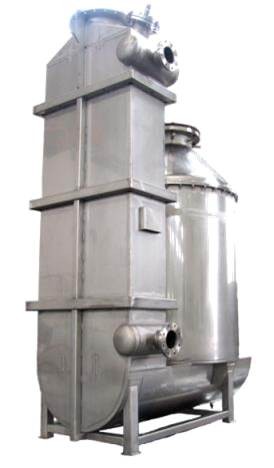
To address these challenges, Shanghai Heat Transfer Equipment Co., Ltd. has developed a plate dehumidification unit with a built-in plate cooler. The unit consists of three main components: a plate heat exchanger core, a condensate collector and a gas-liquid separator.
The plate dehumidification unit adopts a three-stage dehumidification process:
- First-stage dehumidification in the plate cooler The cooling medium exchanges heat with the humid gas through the plate heat exchanger, reducing the gas temperature below its dew point. Moisture in the gas then condenses into fine droplets.
- Second-stage dehumidification in the condensate collector Under the action of gravity and centrifugal force, part of the mist droplets come into contact with the wall surface and settle at the bottom of the condensate collector, further reducing the moisture content of the gas.
- Third-stage dehumidification in the gas-liquid separator The separation components capture the remaining mist droplets, which then flow into the condensate collector. Finally, dry gas is discharged from the unit.
Key Features
- High heat transfer efficiency The heat transfer plates adopt a special corrugated structure, which helps reduce the thickness of the liquid film formed on the corrugation crests. This improves heat transfer efficiency, enhances condensation during the first dehumidification stage and strengthens the overall dehumidification effect.
- Excellent dehumidification performance The optimized flow channel design allows humid gas to flow smoothly through the gas passages while enabling condensate to drain promptly into the lower condensate collector. With three stages of gas-liquid separation, the unit achieves high separation efficiency and stable dehumidification performance.
- Strong corrosion resistance The gas channels and cooling medium channels are completely separated, preventing direct contact between the cooling medium and humid gas and avoiding corrosion caused by cross-contamination. In addition, plate materials can be selected according to different media and operating conditions to ensure reliable corrosion resistance.
- Compact structure Designed for marine installation environments, the unit features a compact footprint and is suitable for various humid gas dehumidification applications where space is limited.
- Anti-clogging design A dedicated cleaning structure is installed above the plate cooler. During maintenance, cleaning liquid is sprayed from the nozzles to flush the heat transfer plate surfaces and remove attached impurities.
Application Results
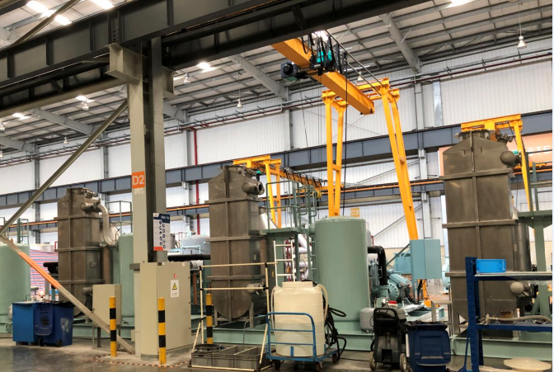
The conventional dehumidification equipment previously installed required shutdown for cleaning and maintenance almost every month. After being replaced with the plate dehumidifier developed by Shanghai Heat Transfer Equipment Co., Ltd., flow channel clogging was significantly reduced, and the maintenance interval was extended to more than six months.
The unit has maintained stable long-term dehumidification performance, effectively reducing hull and pipeline corrosion as well as water accumulation in tanks caused by high-humidity gas.
The plate dehumidifier developed by Shanghai Heat Transfer Equipment Co., Ltd. greatly reduces shutdown time for inspection and maintenance, labor costs and spare parts consumption. It helps ensure continuous operation of the inert gas system and improves the operational safety of vessels. At the same time, the equipment is highly suitable for harsh marine environments characterized by high humidity, high salinity and strong vibration, delivering low overall operating costs and significant economic benefits.
Post time: Jun-29-2026